AHEAD OF GOVERNMENT SHUTDOWN CONGRESS SETS ITS SIGHTS ON NOT-SO-COMPREHENSIVE IMMIGRATION REFORM

File 20180119 80197 1vw54m4.jpg?ixlib=rb 1.1
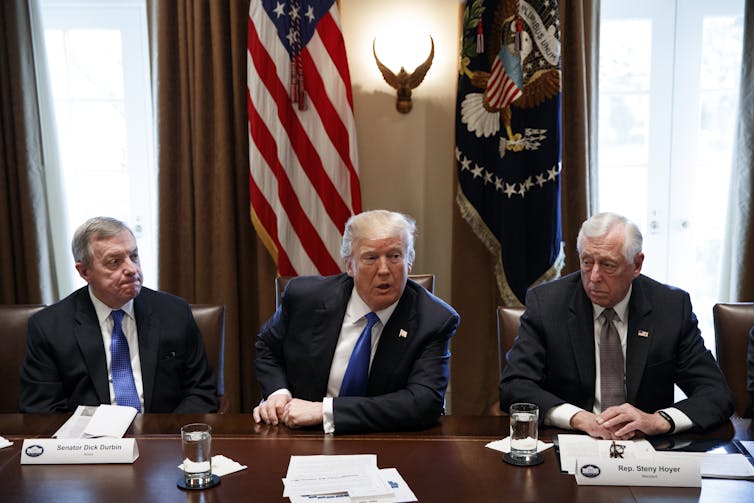
Senators meet with President Donald Trump to discuss immigration on Jan. 9, 2018. AP Photo/Evan Vucci

Matthew Wright,
American University

For a moment, it looked as though 2018 might be the year that ended a three-decade streak of failure to pass so-called “comprehensive immigration reform.”

On Jan. 11, a bipartisan group of six senators brought forth a plan for comprehensive reform that would include US$2.7 billion for border security, a pathway to citizenship for “Dreamers” brought to the country without authorization as children, a limit on those Dreamers sponsoring their parents for citizenship and a reallocation of “diversity visas” to immigrants with recently terminated Temporary Protected Status visas.

Prospects for the deal have dimmed since President Donald Trump, who had previously expressed sympathy for Dreamers, abruptly torpedoed it. But the rudiments of a workable deal are still in place. If it ends up succeeding, it will be in no small part because it sidesteps the one issue that has deadlocked comprehensive reform since the 1990s: undocumented immigrants.

The only remotely viable path to a “comprehensive” deal, it seems, is to leave millions of undocumented immigrants who are not Dreamers out in the cold.

The ‘amnesty’ stumbling block

Americans of all political stripes, and their elected officials, have long agreed that the U.S. immigration system is “broken.” Yet since the last major round of reforms in the 1980s and 1990s, efforts at “comprehensive immigration reform” spearheaded by presidents of both parties and enjoying bipartisan congressional support have gone nowhere. America’s foundational laws regarding immigrants have remained largely intact since Lyndon Johnson occupied the White House. They are the Hart-Celler Act of 1965, later amended by the Immigration Reform and Control Act of 1986, and the Immigration Act of 1990.

The main stumbling block has been hostility, mainly on the Republican side, to normalizing the status of millions of immigrants living in the country without permission. This hostility developed fairly recently, driven almost entirely by pressure to please a small but rabidly anti-immigrant base. George W. Bush largely escaped pressure to harden his relatively moderate positions prior to his election in 2000, and actively pursued comprehensive immigration reform as president.

But since then, serious GOP presidential candidates have increasingly had to toughen up on immigration policy in order to make it through to the general election.

The 2008 election witnessed the rebirth of Rudy Giuliani – formerly a relatively tolerant mayor of a “sanctuary city” – as a border security hawk and illegal immigration hard-liner. More notable still that year was Sen. John McCain, who was forced to back off his longtime support for comprehensive immigration.

Donald Trump, of course, launched his 2016 bid for the GOP presidential nomination by railing against drug smugglers, criminals and rapists he falsely alleged are streaming into the U.S. illegally from Mexico.

Observers understand this hostility to “amnesty” in different ways. Some see it as racially motivated, and tied to hostility against Latinos and other ethnic minorities. However, my colleague Morris Levy and I have shown in our research that much of it is tied to deep conceptions about the rule of law. By this logic, roughly one-third of Americans, according to our study, reject undocumented immigrants categorically. That is, they reject them solely on the basis of breaking the law, without regard to ethnicity or other characteristics.

We have argued that this is why there is still no path to citizenship for the 11 million or so undocumented immigrants currently living in the U.S.

Narrowing what ‘comprehensive’ means

It’s no surprise then that, of late, the debate has devolved exclusively to address the fate of Dreamers. As some of our work indicates, Dreamers do not provoke the intransigent hostility that other undocumented immigrants do. They are less likely to be viewed as “law-breakers,” and more likely to win support on humanitarian grounds.

In effect, the vast majority of undocumented immigrants have been written out of immigration reform altogether. The more limited deal in circulation would give Democrats a “win” with respect to illegal immigration, even if it is less than the total victory they have long sought. The concessions they offer in return – limited funding for border security, some effort to limit so-called “chain migration,” and the redirecting of “diversity lottery” visas to some immigrants previously on temporary status – are not uncontroversial. However, none is likely to generate anything like the reaction “amnesty” produces among categorical opponents of illegal immigration.

Can those undocumented immigrants hope for reprieve down the line?

The ConversationThere is precedent for large-scale amnesty: The Immigration Reform and Control Act of 1986 legalized nearly 3 million undocumented immigrants in exchange for relatively weak enforcement provisions. But given the uniquely intransigent positions taken on both sides of the issue, it is hard to imagine another such bill in the offing any time soon.

This article was originally published on The Conversation.

Democratic Legislative Leaders Unveil Democrats’ “Opportunity Agenda for Working Families”

January 20, 2017

PIERRE, SD – At their weekly press conference today, State Senate Democratic Leader Sen. Billie Sutton of Burke and State House Democratic Leader Spence Hawley of Brookings unveiled the Democratic Caucus’s “Opportunity Agenda for Working Families” – the five main bills Democratic state legislators will focus on the rest of the session.

“Democrats believe that our state’s people are in need of the same kind of investment as the Legislature made in our roads and bridges in 2015,” said Sutton. “South Dakota has the highest rate in the nation of people working multiple jobs and the second highest percentage of families where both spouses are in the workforce. On top of that, we are 44th in the nation for median earnings for men and 46th  for women. Simply put, working families are having to work harder to get by, and many are falling behind.”

“Our agenda represents the kind of frugal, smart investments that will pay the state big dividends in the future,” said Hawley. “If it is passed it will be a huge boost for the working families of South Dakota. As the minority party, we know it will be hard to get our ideas passed through the Legislature, but Democrats intend to work hard to make South Dakota’s economy and state government work for the working families of South Dakota.”

The Opportunity Agenda for Working Families includes the following pieces of legislation:

  • Creating A Pre-K Pilot Program and Restoring Childcare Assistance – to help close the education gap for at-risk youth and alleviate child-care expenses for their parents
  • Fully funding the Building South Dakota Program – to stimulate economic development and provide affordable housing in both large and small communities in our state
  • Funding a Needs-based Scholarship Program – so every South Dakotan has the ability to afford a college or technical school education
  • Guaranteeing Paid Sick and Family Leave for employees of large corporations – which will help working people employed by companies with 50 employees or more care of themselves and their families
  • Removing the Sales Tax on food –to make our tax code fairer for working families

South Dakota Democrats Respond to Governor’s Budget Address

 Democrats Respond to Governor’s Budget Address
December  6, 2016

SIOUX FALLS – The South Dakota Democratic Party  released the following statement in response to today’s Budget Address by Gov. Dennis Daugaard, where it was confirmed that for the second time in three fiscal years (FY 2015 and 2017), revenues have not met adopted projections: 

“GOP policy failures have led the state to once again miss budget projections. Not only that, but farm income was down $1.5 billion last year, and new hires were down 18.7% from last year this October. The Governor’s Address was long on the details of the challenges facing the state in slow revenue growth, but short on detail on what, if anything, he might do to promote economic development.”

“Republicans have had the power to implement the policies they’ve wanted in our state for years now, which we were told over and over again would lead to incredible prosperity and where everything would be great for everybody – businesses, framers, workers, and state government. It’s obvious now, if it wasn’t before, that they have failed to deliver on their promises. It is crystal clear that this is a time for real leadership in state government and not the same old tired way of doing business that got us here.”

Democrat’s will lead in this year’s Legislative Session by pursuing a pro-economic growth legislative agenda that is focused on making South Dakota work for all South Dakotans and increase the transparency and accountability in state government to make sure budgetary decisions are made in the best interest of the State’s people and not to reward the friends and contributors of the political establishment.”

Hermosa Custer County Fair-Food-Chickens-Wine-Cars and Politicians

All Images: Herb Ryan/Custer Free Press


linzpancakesopti81416
Custer County Commissioner Jim Linz readies the grill for pancakes at the Custer County Fair Pancake Breakfast Sunday morning August 14, 2016. Photo: Herb Ryan/Custer Free Press


chickenopti81416
4-H member Hevin-Mairie Adcock holds her Java Rooster at the Custer County Fair Pancake Breakfast Sunday morning August 14, 2016. Photo: Herb Ryan/Custer Free Press


democratsopti81416
Wayne Boots, Sandy Arseneault 2016 Democratic candidate for District 30 of the South Dakota House of Representatives and Mary Boots, Chairman Custer County Democrats at the Custer County Fair Saturday morning August 14, 2016. Photo: Herb Ryan/Custer Free Press


republicansopti81416
John and Anne Van Dis, Tim Goodwin 2016 Republican candidate for District 30 of the South Dakota House of Representatives and his wife Marcia Goodwin at the Custer County Fair Saturday morning August 14, 2016. Photo: Herb Ryan/Custer Free Press


wineopti81416
Blue Ribbon wine winners at the Custer County Fair Sunday morning August 15, 2016. Photo: Herb Ryan/Custer Free Press


Salsaopti811416
First place ribbon, “Salsa” made by Butch Hawking from Rapid City at the Custer County Fair Sunday morning August 14, 2016. Photo: Herb Ryan/Custer Free Press


quiltsopti81416
A selection of quilts at the Custer County Fair Sunday morning August 15, 2016. Photo: Herb Ryan/Custer Free Press


lineupopti81416
Car show at the Custer County Fair Sunday afternoon August 15, 2016. Photo: Herb Ryan/Custer Free Press


redfordopti81416
Car show at the Custer County Fair Sunday afternoon August 15, 2016. Photo: Herb Ryan/Custer Free Press


vwcamperopti81416
A pumped up “VW” towing a custom camper at the Custer County Fair Car Show Sunday afternoon August 15, 2016. Photo: Herb Ryan/Custer Free Press